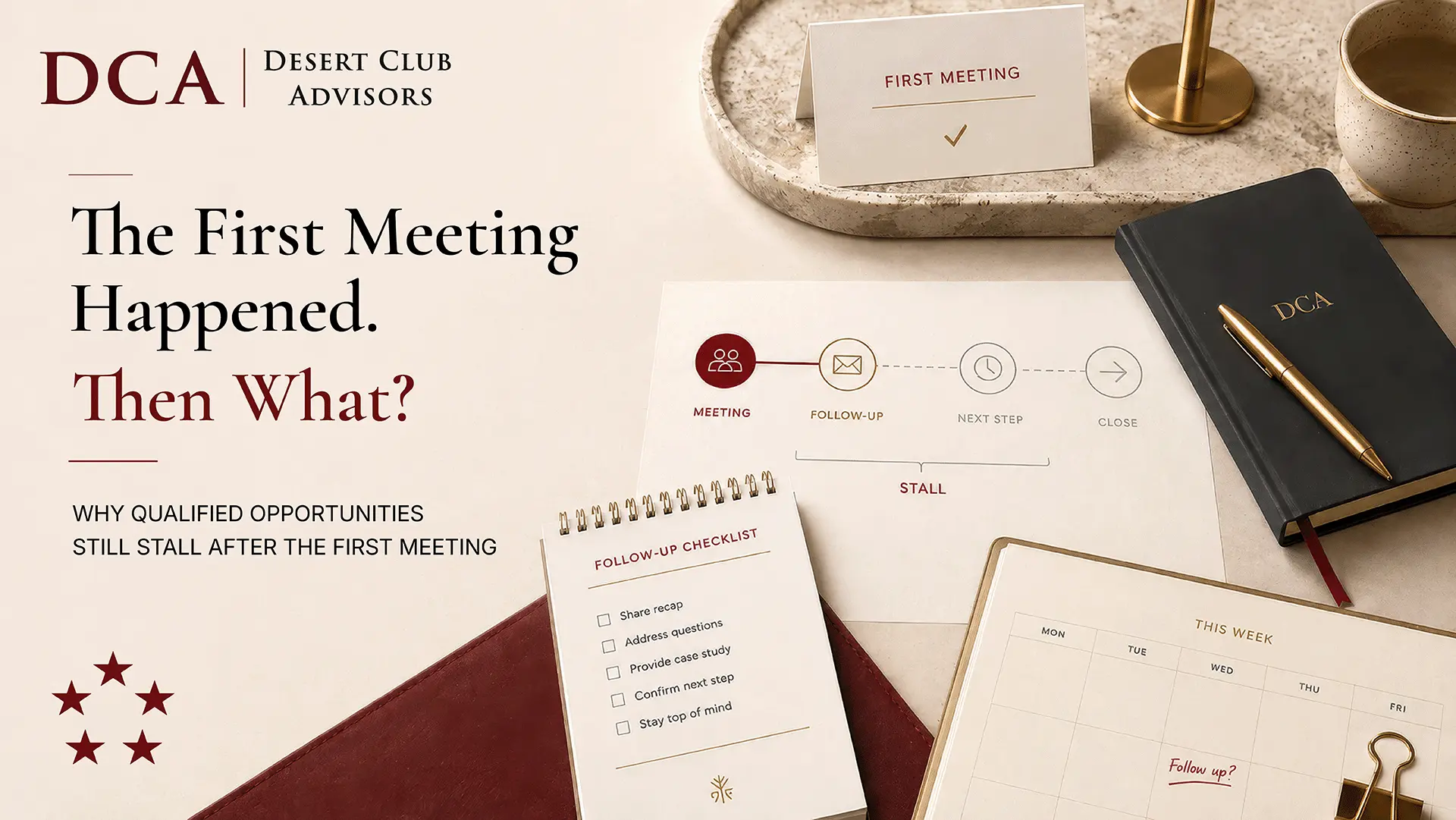
More meetings can feel like momentum, but that doesn’t mean they are creating a meaningful pipeline.
Many businesses engage salespeople for outbound with the “simple” goal of getting more meetings. We’ve all been taught that sales is a numbers game, so the goal feels like it just makes sense. Meetings feel tangible and give the founder something to react to, and the business something to report.
But more meetings don’t necessarily mean better quality prospects.
A full calendar can look like traction but be quietly hiding low-fit conversations, unclear next steps, weak qualification, and a pipeline that looks healthier than it actually is.
Instead of asking how many meetings sales is generating, a better question to ask is:
Are our outbound efforts creating real pipeline, or just filling our calendars?
Your time is expensive, and every meeting that should not have been booked takes time away from active customers, product improvements, strategic relationships, and other internal matters that also drive business forward.
Outbound should create leverage, not additional work of sorting through weak conversations.
What is the Difference between a meeting and real pipeline opportunity?
It is a subtle distinction that often goes overlooked without real sales framework.
A meeting is a scheduled conversation. Pipeline opportunity is created when a meeting becomes a qualified commercial conversation that has entered a defined sales process.
Someone may take a meeting because they are curious, polite, loosely interested, or gathering information about what your company does. That doesn’t necessarily mean that they have a meaningful business problem, buying influence, urgency, budget access, or a reason to continue the conversation beyond the first meeting.
A real pipeline opportunity usually has a few clear characteristics:
· The prospect account fits within the defined ICP.
· The contact has a relevant target role and/or influence in the buying process.
· Discovery produces a clear problem that connects to your offer and resonates with the contact or buying group.
· The potential value to the customer justifies continued conversations.
· There is a clear next step at the end of the first meeting.
The most meaningful outbound efforts don’t just generate quality meetings. They should help identify where the market is showing real interest, and which accounts deserve continued consideration.
A note on why meeting count became the wrong metric
Simply, because it is easy to measure.
It is much easier to say that “we booked x number of meetings this month”, than it is to explain whether those meetings were with the right companies, whether the buyers understood the problem, whether the value prop was explained sufficiently, whether the conversations actually advanced, or whether the company learned something from the conversation.
It is also a problem that allows teams to optimize for the metric they are judged upon.
If the main goal is to “get meetings”, then the standard for what qualifies as a meeting often gets lower. Targeting becomes broader. Messaging becomes more generic, or worse, more aggressive.
As a result, prospect qualification gets moved to after the meeting rather than before. And putting the cart before the horse is always dangerous.
Here are 5 signs that your outbound efforts are creating real pipeline
Healthy outbound should be measured by the quality of the commercial signals it creates. Sure, meeting count still matters, but it should sit behind better questions.
1. The right accounts are responding
The first sign of a strong outbound program is that people in relevant roles from target accounts that fit your ICP are responding.
If they are not responding, the answer may not be more outreach. It may be adjusting your targeting, positioning, offer clarity, or timing.
2. The meeting has a reason beyond curiosity
Curiosity is not the same as demand.
A prospect may accept a meeting because the message was interesting or the topic was loosely relevant. That can be useful in early market development, but if most meetings are based on curiosity, your pipeline is probably weaker than it appears.
Stronger outbound pre-frames the meeting and creates clear reasoning behind them. The prospect should have a recognizable problem with an initiative pending or underway, is dealing with a constraint, or sees a possible connection between your offer and an internal priority.
3. The first conversation creates a specific next step
Your first meeting with a prospect becomes significantly more meaningful when it creates a tangible next step.
It doesn’t always need to be another demo, or even an immediate proposal. In complex sales, the next step may be another stakeholder conversation, a deeper discovery, an internal review, technical validation, or follow up around a specific use case.
Strong next steps include languagelike:
· “Let’s include other departments/leaders/teams who own this effort”
· “Show us more about how this would apply to [a specific effort]”
· “We are reviewing this [effort or area] next month, can you follow up before then?”
· “Send over pricing so we can compare it to our current”
If your meetings consistently end without a clear next step, your campaign may be producing conversations rather than opportunities.
4. The conversation reveals useful commercial information
In addition to generating demand ,quality outbound generates an opportunity for learning more about the market.
A healthy outbound program should help you further understand how the market thinks, which objections are most common, what language is most effective, and where your offer would benefit from the most refinement.
Outbound helps sharpen the entire commercial strategy when it reveals things like:
· The strongest pain point is different than the one emphasized in the messaging.
· The assumed buyer or decision maker is not the ultimate buyer or decision maker.
· Prospects understand the category differently than the company does.
· The offer is too broad.
· Pricing creates hesitation before the value is understood.
This is where outbound becomes more than just appointment setting, it becomes part of the company’s commercial strategy.
5. Opportunities can be tracked with discipline
If every meeting becomes an opportunity, it is easy for pipeline to get inflated quickly. Real outbound needs qualification standards. It doesn’t need to be complicated, but the criteria should be clear.
For example:
· Does the account fit the defined ICP?
· Is there a defined business problem relevant to the offer?
· Is the contact connected to the buying process, and where do they fit?
· Have next steps been agreed upon?
· Is the opportunity worth continued founder or sales involvement?
· Is there a possible revenue opportunity within a realistic timeframe?
Without this discipline, pipeline starts to look encouraging in a CRM, but doesn’t help the business make better decisions.
Here are some warning signs that outbound is just creating activity
The warning signs usually appear in the gaps between meetings booked and opportunities advanced. Some common warning signs include:
· Meetings booked with companies that don’t match the ICP.
· Prospects who accept a meeting without much more than curiosity.
· Discovery calls that repeatedly end with vague interest and no next step.
· The founder spends more time explaining rather than discussing a buyer’s problem.
· Most opportunities stall after the first call.
· Sales can not explain why certain accounts were targeted.
· Meeting volume increases, but qualified pipeline does not.
· The company can’t distinguish between curiosity, interest, and intent.
What to measure, if not meetings booked?
While meeting count is still useful, it should not be the primary measure of success. A stronger outbound scorecard should include things like:
· ICP fit
· Contact relevance
· Number of Qualified Meetings
· Meeting to next step conversion
· Opportunity progression
· Segment-level response quality
· Recognition of Objection Patterns
· Market learning capture
These are a good starting point for businesses to get a more accurate view of whether outbound is developing a repeatable motion and creating real pipeline, or simply producing activity.
Outbound should be the commercial foundation
The best outbound programs do more than book meetings.
They help a company learn how to talk about its product, which accounts are worth pursuing, which buyers care, what problems matter, and what kind of follow-up is needed to carry a conversation forward.
Quality outbound creates a stronger commercial foundation that can eventually support internal sales with clear positioning, defined target account criteria, practical qualification standards, tested outbound messaging, and a realistic understanding of what converts.
For founder-led and growth-stage businesses, this is the larger value of disciplined outbound, and when it is treated this way, meetings become part of a larger commercial system.
So, are more meetings better?
Well, sometimes.
More meetings are better when they are with the right accounts, right people, connected to real business problems, and moving though a defined and disciplined process.
The real measure is whether outbound efforts are producing meetings that help the business crate qualified conversations, advance real opportunities, and build a more repeatable commercial motion.
For growing companies, that distinction can be the difference between activity and progress.