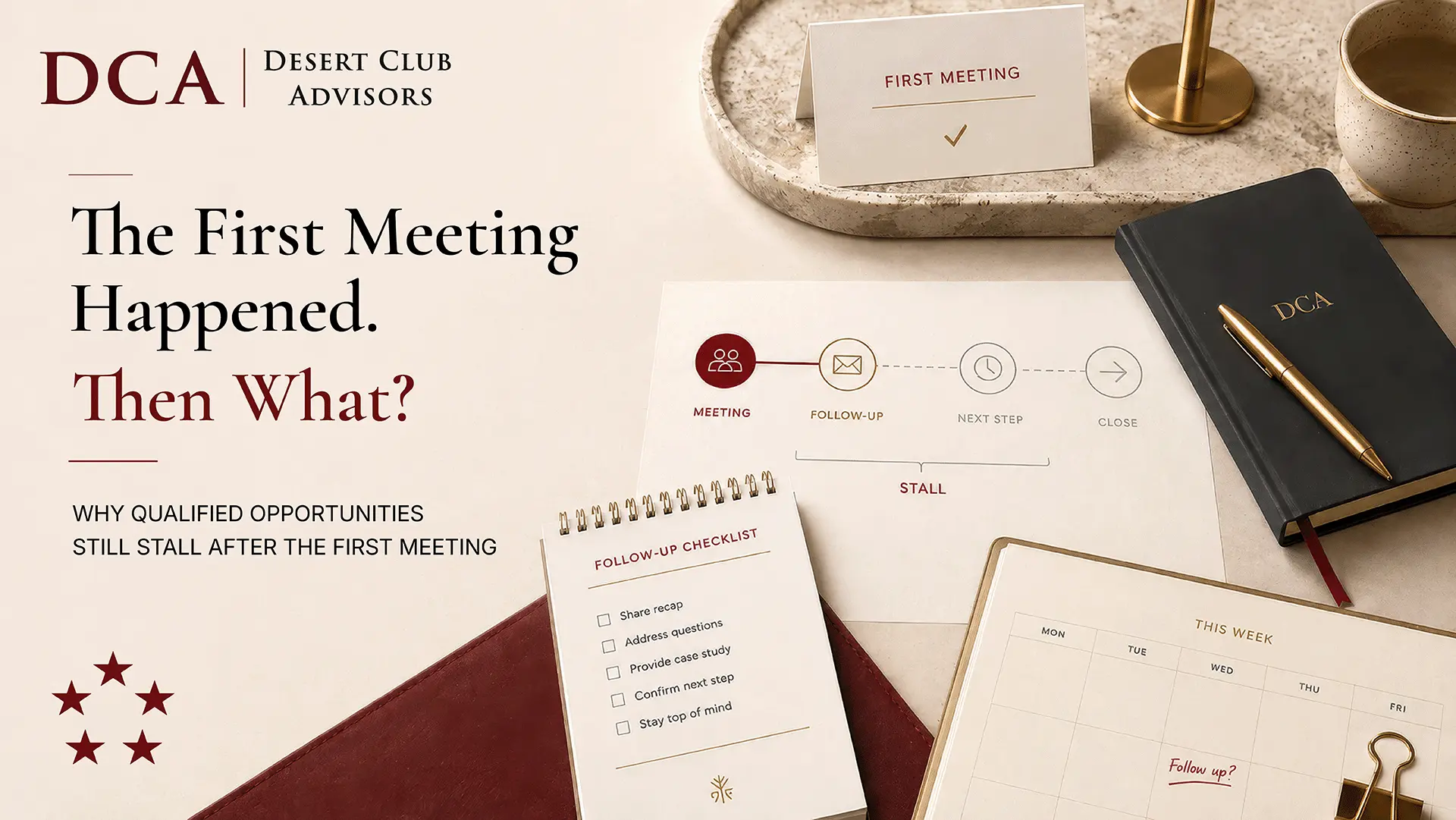
Getting the first sales meeting is important. It is also difficult. But it is not the same thing as creating pipeline.
For most businesses, the first meeting feels like the hard part. It is tedious and you deal with a lot of rejection. Then, a prospect finally agrees to a conversation. They show up, ask good questions, and might even confirm there is a relevant problem. Then the meeting ends, you follow up – sometimes even with documentation – and the opportunity goes quiet.
So, was the prospect ever serious?
Sometimes they weren’t. But more often, just like not really having a structure to get to the first meeting, there isn’t enough structure after the meeting to convert initial interest into action.
A qualified meeting is only the beginning
It is common to treat the first meeting as the first milestone. And it is. But that first meeting is also filled with milestones of their own.
a. Were you able to get the prospect to warm up to you?
b. Did the prospect express urgency, a clear problem you can solve, or both?
c. Did the prospect leave in alignment with a clear understanding of your value proposition?
d. Did both sides understand who else needs to be involved, next?
e. Were there clearly defined next steps for both parties?
A meeting can be cordial, pleasant, relevant, and even qualified without becoming a real sales opportunity. This is why “more meetings” can create a false sense of progress.
Why good meetings still stall
Sales is one of those simple things that gets complicated by our tendency to become stressed and overthink.
The prospect may like the founder or someone they know at your company. They may understand your product, but not the business case. They might recognize a problem exists, but not feel the urgency to prioritize it. They may agree your solution solves a problem, but still be unclear on what buying, implementing, or gaining approval would require. They might know all of these things, but not know how to justify the next step internally.
In smaller or founder-led organizations, this is especially common because one person often carries the majority of both the effort and the commercial context, personally.
Without the ability to translate that context and assist your prospects with a clear process that helps make buying easy, the opportunity can quietly lose momentum.
Interest is not the same as advancement
One of the most important distinctions that often gets overlooked in sales is the difference between interest and advancement. One of the ways you can tell the difference is the level of specificity the prospect uses.
Interest sounds more vague, like:
“That was helpful.”
“Send me some more information to review.”
“This sounds like something that would make a difference.”
“You should circle back in a couple weeks after I talk to so-and-so.”
Advancement sounds more concrete, like:
“This was helpful, we’ll need to include so-and-so in a meeting, next.”
“We need to compare this against our current, can we schedule a technical review?”
“Can you send pricing before our internal planning meeting, next week, so we can help our CFO understand the impact?”
“Our availability for a follow-up, next week, is this.”
That doesn’t mean that interest should be discounted, it can be very encouraging and lead to advancement in the future. But advancement is directional, it tells you that the prospect is doing or deciding something, involving someone, or committing to a next step that moves the opportunity forward.
A strong post meeting process should help identify that difference.
Follow up should do more than recap the call
A lot of follow up emails are too passive. They thank the prospect for their time, attach a deck, and suggest reconnecting or “circling back”. Sure, it’s polite, but politeness doesn’t always create clarity.
A stronger follow up should reinforce the reason for the conversation and why you’re building a relationship. It should summarize what was heard, clarify the potential fit, identify open questions, and recommend a logical next step. The idea is to document the process while making the next steps easy to understand and sell internally for your prospect.
At DCA, we use meeting minutes to provide clear follow up with answers to questions like:
1. What problem did the prospect confirm?
2. What impact does that problem have and can we quantify it, yet?
3. What does each role care about the most?
4. Who else needs to be involved, on both sides?
5. What information does the prospect need to evaluate fit, and how can we help deliver that information in a way that is most easily digestible?
6. What clear action items exist for each participant?
7. When is the next conversation, follow up, or deadline scheduled for?
Because when we remove work from the buyer’s plate by providing them a clearer path, their ability to see the light at the end of your tunnel becomes clearer, too.
Revenue execution happens between interest and decision
Sales isn’t something that happens only when you’re in front of a prospect or customer. It happens in the work around the meeting, in the hours no one sees. It’s in the diligent preparation, thoughtful positioning, intentional follow up, and careful internal coordination. It is orchestrated by sober judgement of when to push, when to clarify, when to pause, and when to take a step back and reframe. This is the often overlooked ‘middle-earth’ of sales.
Sales isn’t pure lead generation; it isn’t only closing. It also includes the revenue execution process; the work required to help convert qualified conversations into real opportunities, and real opportunities into informed decisions.
For founder-led, and growth ready organizations, this could mean the difference between a busy calendar and a credible pipeline. Because they aren’t the same and most executives don’t need more activity for activity’s sake. They need a clearer way to move qualified conversations forward.
Generating the first meeting is just the beginning. What happens next determines whether the conversation has a path to opportunity.
DCA helps businesses carry qualified opportunities forward with clearer follow up, stronger commercial coordination, and more disciplined next steps.