For many founders, hiring the first salesperson feels like the moment the business starts to become more scalable.
The founder is busy. Opportunities are being missed. Sales conversations are taking too much time. The business needs more pipeline, more follow-up, and more consistency. Hiring a salesperson seems to be the obvious answer.
Sometimes that’s the right move. But many founders hire their first sales rep too early, or for the wrong reason. They assume an experienced, professional salesperson will come in and create the sales function, when in reality, the business may not yet have enough commercial structure for that person to succeed.
A first sales hire can help expand what is already working. But before that hire can succeed, the business needs some clarity around who it sells to, why those buyers care, how opportunities are qualified, what makes deals move forward, and what a good sales conversation looks like. If that foundation has not been set, the salesperson may inherit more ambiguity than opportunity.
The better question to ask, rather than “is it time to hire a salesperson”, is: “What needs to exist before a salesperson can be effective?”
The first sales hire is often made for the wrong reason
Too often, founders don’t hire their first salesperson because the business is ready. They hire because the founder is tired. Tired of being stretched thin. Tired of chasing prospects. Tired of trying to build the business while also being the entire sales function. Being tired of sales is not the same thing as being ready to hire sales.
At a certain point, the founder’s time becomes too valuable to spend on every early-stage sales conversation, every cold prospect, and every unqualified lead. While a founder may want someone to “take sales off their plate”, that only works if there is something clear to hand off. If the sales motion still depends on the founder’s instincts, relationships, credibility, and ability to explain the business in real time, then the handoff is probably premature.
In that situation, the salesperson is not stepping into a defined role. They are being asked to discover the market, clarify the message, qualify buyers, build pipeline, interpret objections, manage deals, and create the processes to do so, while being judged on sales results. That is a difficult assignment, especially for a front-line salesperson who does not yet have the founder’s context.
Hiring a salesperson does not automatically create a sales function
One of the most common mistakes in founder-led companies is confusing a sales hire with a well-defined sales function. Salespeople perform best when they are operating inside a system with clear direction, not when they are forced to invent that system alone.
A sales system can include guidance for positioning, ICP target account logic, messaging, qualification standards, deal stages, follow-up expectations, objection handling, CRM discipline, sales materials, and a shared understanding of what a good opportunity looks like. Without that foundation, the first salesperson is often forced to improvise. They may create their own pitch. They may pursue the wrong accounts. They may qualify prospects too loosely. They may focus on activity because no clearer standard has been defined.
This is where frustration starts to build on both sides. The founder expects the salesperson to generate revenue while the salesperson expects the company to know how to go to market.
Neither side is necessarily wrong here. The root problem is that the business tried to hire into a gap that should have been clarified first. A strong salesperson can improve a commercial system but should not be expected to invent the entire system from scratch.
The business may be ready when demand is becoming repeatable
A founder doesn’t need everything to be perfect before hiring the first salesperson; things rarely are. Messaging is still evolving and the sales process may still be uneven. But there should be signs of repeatability.
The business may be ready for its first sales hire when the founder can point to patterns in the market. Certain types of buyers respond better than others. Certain problems and objections come up repeatedly. Certain messages create stronger conversations. Certain use cases are easier to sell.
The business should also be able to show some evidence of who the business should (and shouldn’t) pursue, why buyers care, what creates urgency, and what usually needs to happen before a deal can move forward. This matters because a salesperson needs more than a product and a list of accounts to be successful. They need a working theory of the market.
Without it, the salesperson will have to guess. And guessing is not a sales strategy.
What should exist before the first sales hire
Before hiring the first salesperson, a founder should have enough commercial clarity to make the role teachable. That doesn’t require a massive sales playbook or a polished training program. But it does require seven basic building blocks of a transferable sales motion.
Positioning
The company should be able to explain what it does, who the products or services are for, why that matters, and why now. If the founder can’t define this clearly, the salesperson will struggle to create consistency in the market.
Target Account Logic
The business should have a clear view of which companies, buyers, or customer types are worth pursuing, and why. It doesn’t need to be perfect, but it should be more specific than “I want to make sales” or “any company that could use this.” A salesperson needs direction. Without it, they may spend valuable time chasing accounts that were never likely to convert.
Messaging
The business should be able to provide a reasonable starting point for outreach, discovery, and sales conversations. The salesperson should understand which problems to lead with, which outcomes matter, and which language tends to create interest.
Qualification Criteria
The company should know what separates a real opportunity from a polite conversation. This includes buyer fit, pain, urgency, authority, timing, budget, and the presence of a real business problem. Without qualification standards, the business may not be able to tell whether the salesperson’s pipeline is genuinely viable or simply active.
A Basic Sales Process
The business should understand the normal path from first conversation to closed deal. It is never linear, but the business should know: What usually happens after a prospect shows interest? Who needs to be involved? What information is exchanged with prospects? What causes deals to stall? What are common next steps?
Objection Handling
The founder should be able to explain the most common objections and how they are usually handled. Price, timing, priority, competition, internal resources, and perceived risk are all useful to document. A salesperson should not have to discover every objection in the dark.
Examples of Wins and Losses
A first salesperson needs context. They should know why recent customers bought, why others didn’t, what mattered in the decision, and what the founder learned along the way. These examples often carry more practical value than a formal training deck.
Together, these pieces create a foundation that sets the first salesperson up for the greatest probability of success.
What happens when these things do not exist
When the business hires a first salesperson before a commercial foundation exists, the problems usually show up quickly.
The salesperson may produce activity but not traction. Their booked meetings may not convert. Their pipeline may be full of weak opportunities. They may struggle to explain the value proposition or focus on the wrong opportunities. They may even become dependent on the founder to rescue important conversations.
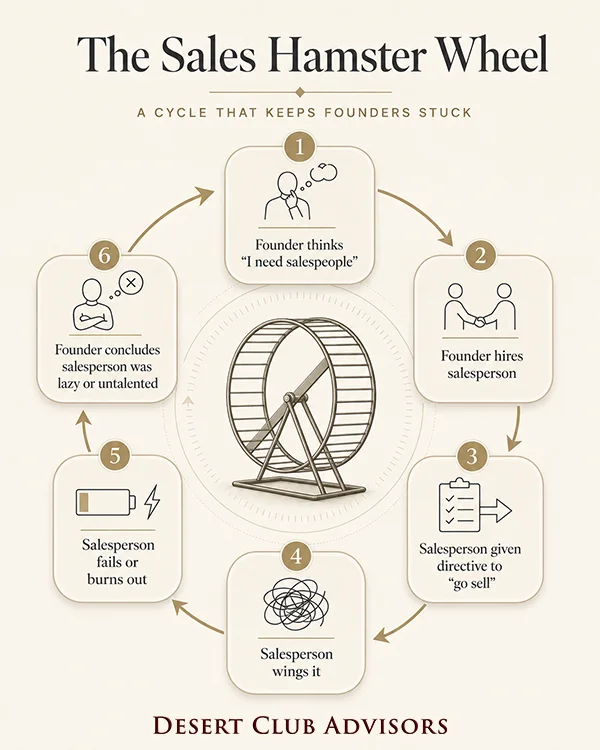
What commonly happens is the founder concludes that the salesperson was not good enough. Sometimes that is true, many first hires fail because they weren’t the right fit. More often, however, the deeper issue is that the company was not ready to properly support the role. This creates a dangerous and costly cycle.
The founder hires a salesperson to reduce founder dependency. The salesperson struggles because too much knowledge still lives inside the founder’s head. The founder gets pulled back into sales. The salesperson loses confidence while the founder loses trust. Eventually, the hire fails and the company becomes more skeptical of salespeople.
These types of failures can be expensive. Not just because of compensation, but because of lost time, lost market lessons, damaged prospects, and the emotional cost of starting over – sometimes again and again.
When a salesperson is the right next step
A first salesperson may be the right next step when the business has already proven enough demand and the founder can transfer enough knowledge for someone else to operate effectively. That doesn’t mean the founder disappears from sales. In many cases, the founder should still be involved in strategic conversations, important deals, product feedback, and market learning.
But the founder should not be required for every conversation to make sense. A first sales hire is more likely to succeed when the founder can say:
· We know who we are targeting.
· We know what problem we are leading with.
· We know what makes a prospect qualified.
· We know what a good first conversation looks like.
· We know the most common objections.
· We know what types of customers are most likely to buy.
· We know where the salesperson should focus first.
Salespeople can help create more reach, more consistency, better follow-up, and more disciplined execution. They can also bring back valuable information from the market. The best way to set them up for success is to give them a foundation to work from, not a blank page.
When commercial groundwork is the better next step
If the founder can’t yet explain the sales motion clearly, the next step may not be hiring a salesperson, it may be commercial groundwork. Groundwork that turns the founder’s instincts, conversations, customer knowledge, and market observations into a clearer commercial architecture. It means clarifying the ICP, sharpening the positioning, developing better outreach logic, defining qualification standards, and documenting the patterns that already exist in the founder’s sales conversations.
The goal isn’t to create a theoretical sales playbook that sits unused. It is to build enough structure from actual selling efforts that a future salesperson has something practical to work from.
This is especially important for founder-led businesses where the founder has been personally carrying sales. In those businesses, a sales process often exists, along with knowledge about which buyers are serious, which objections matter, and what messages tend to land – but informally inside the founder’s head.
Until that knowledge is made visible, it is hard to transfer. And a salesperson cannot execute what has never been defined.
The first sales hire should inherit a foundation, not a mystery
Hiring a salesperson can be a smart growth decision, but it should be treated as a readiness decision, not just a staffing decision. The first salesperson should not be expected to solve every unanswered question alone. They should not have to create the positioning, define the ICP, create the messaging, qualify the market, build the process, and generate revenue all at once.
The better path is to build a commercial foundation first. Clarify who you are selling to and why they buy. Document how opportunities are qualified. Capture the language that drives better conversations. Define deal stages. Learn from the wins and losses, then hire someone into a system that has enough shape to be taught, tested, and improved.
Salespeople can help your business grow, but only if they are stepping onto solid ground.
Before you hire into ambiguity, DCA helps turn the commercial knowledge currently living in the founder’s head into clearer positioning, outreach logic, qualification standards, and a stronger foundation for your first or next sales hire.